
Thank you for choosing to know your HIV status. Taking an HIV test is an important step towards protecting your health and the health of others. This self-test kit is designed to help you test privately, safely, and conveniently.
Before you begin, please take a few minutes to read the information below carefully.
Transmission & Risk Factors
Please note that HIV can be transmitted through unprotected vaginal or anal sex, sharing needles or other injecting equipment, from an infected mother to her baby during pregnancy, childbirth or breastfeeding, through transfusion and infected blood.
Your risk of HIV may be higher if you have sex without a condom or other prevention method, have multiple or overlapping sexual partners, have a partner whose HIV status is unknown or who has untreated HIV, have a sexually transmitted infection, or share needles or injecting equipment.
Also note that, HIV is not spread through hugging, shaking hands, sharing food or utensils, using the same toilet, swimming together, coughing or sneezing, or mosquito and other insect bites.
After a person is exposed to HIV, it may take some time before the virus can be detected by a test. This period is called the "window period." The duration is approximately 6 to 12 weeks (3 months). During this period, HIV self-test may not yet detect the infection. However, an infected person can transmit the virus.
If you have had a recent exposure and possibly become infected, your test result may indicate non-reactive. This is because your body may not have produced sufficient antibodies to the detectable level that can be picked up by a test kit. You would need to repeat the test after 3 months.
Before testing, carefully read and follow the instructions in the leaflet provided with your HIV self-test kit. Follow each step exactly as indicated.
Check your result only within the time recommended in the test instructions. Do not read the result too early or after the recommended time, as this may lead to an incorrect result.
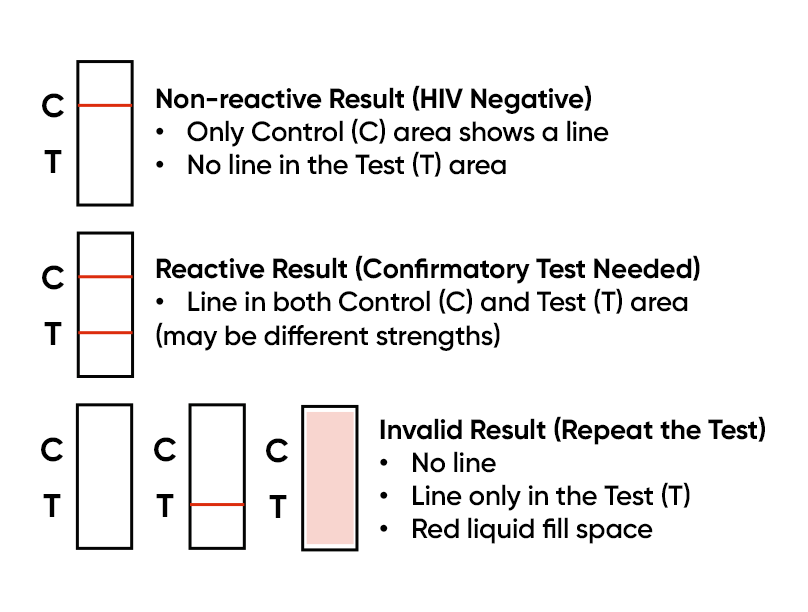
Your test result may be reactive, non-reactive, or invalid.
Reactive: A reactive test result (2 lines on the "C" and "T") means there is possible HIV infection. However, this is not a final diagnosis. You are encouraged to visit an ART Centre, as immediately as you can, for confirmatory testing.
Non-Reactive: A non-reactive test result (1 line on the "C" only) means that the test did not find any sign of HIV infection. However, if you have had a recent exposure, you may need to test again after 3 months for confirmation.
Invalid: An invalid result (no line, a line on the "T" only or red liquid filling space) means the test did not work properly. Do not interpret it as reactive or non-reactive. Request for a new kit and repeat the test or seek help from the GHANET Helpline.
Your result shows possible HIV infection.
Please remain calm. As stated above, a reactive self-test result is not a final diagnosis and should be confirmed at an ART Centre as soon as possible. It is very important that you seek confirmatory testing.
If your result is confirmed HIV negative, please refer to the prevention tab under the "HIV Overview" dropdown/page.
If your result is confirmed HIV positive, immediate linkage to treatment (antiretroviral therapy) is very important. We understand that receiving this result may elicit emotions and concerns. However, rest assured that support is available. You may contact the GHANET Helpline
A non-reactive test result means that there were no signs of HIV infection and you are HIV negative. However, please take note:
We encourage you to remain HIV negative. Some available HIV prevention strategies and services that may be helpful for you include:
PrEP and PEP are available at some ART centres and may be administered based on assessment of risk level.
HIV treatment is available free of charge at government health facilities and designated ART centres. The list of ART centres across the country is available on ART Centres Page.
If HIV is confirmed, starting treatment early helps you stay healthy and, when the viral load becomes and remains undetectable, prevents sexual transmission of HIV.
Your HIV self-test and results are private. If you have questions or concerns before, during or after testing, you can speak with GHANET Helpline for support.
HIV Treatment & Support Services
There are effective treatments available for HIV. Antiretroviral medications (ARVs) can help people living with HIV stay healthy and live long lives. In Ghana, ARV treatment is available, free of charge, at government health facilities. ART Centres Page
You may also be linked to:
If you need assistance, you may contact the GHANET Helpline to help direct you to the appropriate facility.
Thank you for taking this important step to know your HIV status. Whether your result is negative or positive, support, prevention, treatment, and care services are available to help you stay healthy and informed.